Wood Screw Size Chart
Pick a screw gauge number (like #8) and see its diameter in inches, fractions and millimeters, with the threads per inch.
Recent
Your last 10 settings, saved only in this browser. Nothing is uploaded.
How to use the wood screw size chart
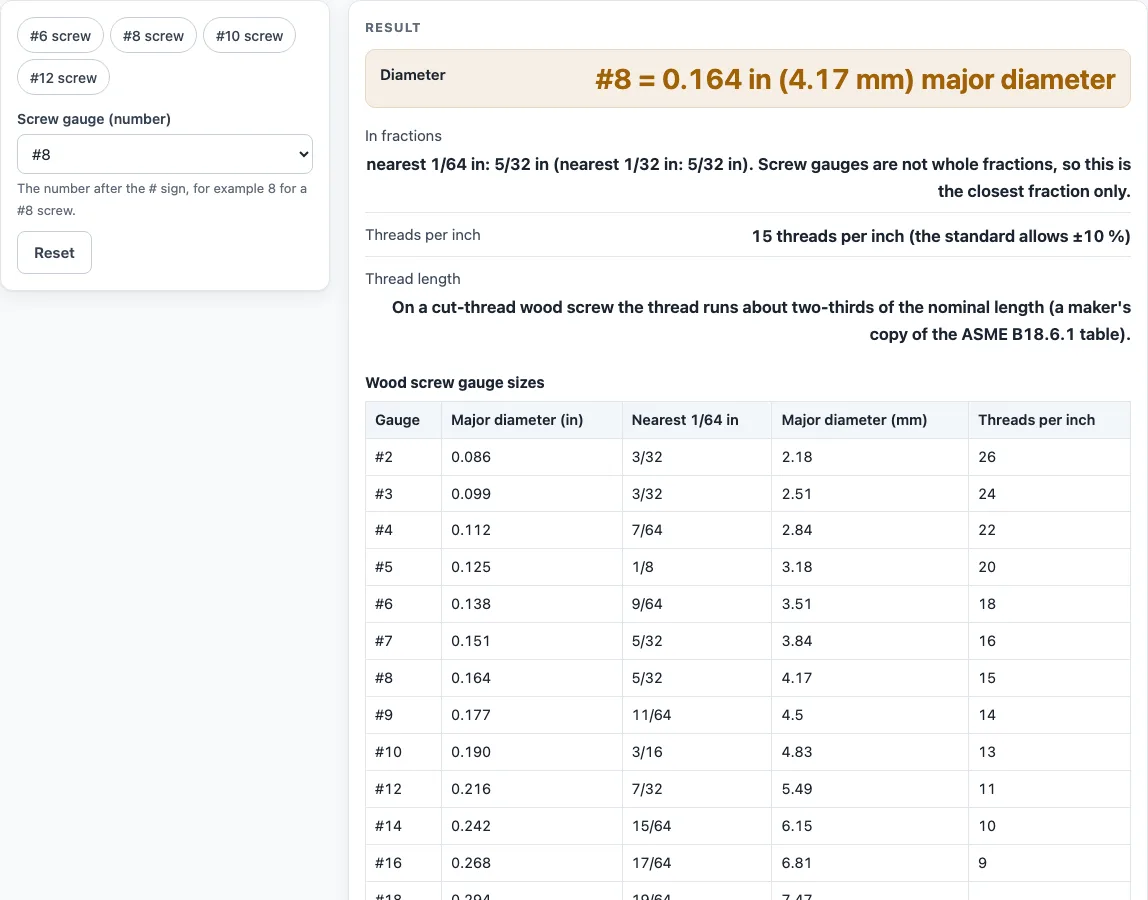
- Find the gauge number of the screw you have or the one your project calls for. The list covers #2 to #10, then #12, #14, #16, #18, #20 and #24.
- Pick that number in the “Screw gauge (number)” control, or use a #6, #8, #10 or #12 preset. The results update from the gauge you choose.
- Read the major diameter in decimal inches. For #8, the result is 0.164 in.
- Read the nearest fraction. This is only the closest 1/64 inch, so #8 shows 5/32 in. The real size sits between 5/32 and 11/64 in, so the fraction is a rounded guide, not an exact match.
- Read the diameter in millimeters. For #8, the result is 4.17 mm.
- Read the threads per inch. Gauges #2 to #16 show a count, such as 15 for #8. Gauges #18, #20 and #24 show no threads per inch and a note, because the thread table used stops at #16. The “Thread length” result adds that on a cut-thread wood screw the thread runs about two-thirds of the nominal length.
- Repeat steps 2 to 6 for each gauge you want to compare.
- Before you drill, confirm the size against the screw packaging or the maker’s data. Sizes vary by maker, and the standard is the reference.
Everything is calculated in your browser. Nothing is uploaded, no sign-up is needed, and the tool is free to use. Because the results come from the gauge you enter, the page gives you the same answer each time you pick the same number.
How does a wood screw gauge number set its diameter?
The gauge number sets the major diameter of the screw, the widest measurement across the threads. The rule is diameter in inches = 0.060 + 0.013 × gauge number. This rule gives every nominal diameter printed in a maker’s copy of the ASME B18.6.1 table for #2 to #16, and in the Wood Handbook Table 8-9 for #18, #20 and #24.
Take #8 as an example. Multiply 0.013 by 8 to get 0.104, then add 0.060 to get 0.164 in. Converting that to millimeters gives 4.17 mm. The same rule gives 0.138 in for #6, 0.190 in for #10, 0.216 in for #12 and 0.268 in for #16. For #18, #20 and #24, it gives 0.294 in, 0.320 in and 0.372 in. The table and the formula agree for all 15 gauges, so the chart and the rule give the same result.
The fraction column needs care. It shows only the closest 1/64 inch, and gauge sizes are not whole fractions of an inch. That is why #8 shows 5/32 in while its real size lies between 5/32 and 11/64 in.
Why do threads per inch fall as the gauge number rises?
Threads per inch are listed for each gauge, and the count drops as the gauge rises. The list runs from 26 for #2, through 18 for #6, 15 for #8 and 13 for #10, down to 9 for #16. These counts are allowed to vary by plus or minus 10 %, so a real screw may differ slightly from the number shown.
On a cut-thread wood screw, the thread runs about two-thirds of the nominal length, according to a maker’s copy of the standard. The thread table stops at #16, which is why the page shows a note instead of a count for #18, #20 and #24.
The 1981 edition of the standard states that the tables govern over the formulas, and the formula is only a restatement of them. For this reason, treat the table values as the reference and the formula as a way to reproduce them.
The page lists no drill or pilot hole sizes and no standard lengths. For wood screws, the Wood Handbook says the hole for the shank is the same diameter as the shank or slightly smaller. The hole for the threaded part is the root diameter of the thread in dense wood, or slightly smaller in low-density wood. The lag screw pilot hole page shows the Wood Handbook figures for lag screws.
Sources (checked 15 October 2026): cdefasteners.com · research.fs.usda.gov
Worked examples
| Input | Result |
|---|---|
| #8 wood screw | 0.164 in (4.17 mm) |
| #6 wood screw | 0.138 in (3.51 mm) |
| #10 wood screw | 0.190 in (4.83 mm) |
| #12 wood screw | 0.216 in (5.49 mm) |
| #20 wood screw | 0.320 in (8.13 mm) |
Calculated by the tool above; open it with the same values to see each step.
Frequently asked questions
What does the wood screw size chart show?
It shows the major diameter in decimal inches, the nearest 1/64 inch fraction and the diameter in millimeters for a gauge from #2 to #24. For gauges #2 to #16, it also shows threads per inch.
What does #8 mean on a wood screw?
#8 is a gauge number. Its major diameter is 0.164 in, or 4.17 mm, and it has 15 threads per inch. The gauge number describes the screw size, not a length.
Are the sizes on the chart exact for every maker?
No. The results are calculated from the gauge you choose, and typical sizes vary by maker. The standard governs, so check the maker’s data for a specific product.
Why does the fraction column only show the nearest 1/64 inch?
Gauge sizes are not whole fractions of an inch, so the chart rounds each diameter to the closest 1/64 inch. Use the decimal value when you need more precision.
Why are there no threads per inch for #18, #20 and #24?
The thread table used for this chart stops at #16. The page shows the diameter for those gauges and a note in place of a thread count.
Does the chart list drill bit or pilot hole sizes?
No. The page lists no drill or pilot hole sizes and no standard lengths. The Wood Handbook guidance on hole sizes is described in the explanation above.
Related tools
- Lag Screw Pilot Hole Size Chart: Use it when you need pilot hole guidance for lag screws in wood.
- Metric Bolt Size Chart: Use it when your fastener is sized in metric bolt dimensions rather than wood screw gauges.
- Nail Size Chart: Use it when you are comparing nails instead of screws.
- How Many Screws per Sheet of Drywall: Use it when you are planning how many screws a drywall job needs.
- Nails, Screws and Bolts: The full set of fastener tools on this site.
- 2x4 Dimensions: Use it when you need the actual size of a 2x4.
- Lumber Dimensions: Use it when you need the actual size of a nominal board.