Nail Size Chart
Pick a penny size (like 16d) or a nail length and see its length in inches and mm, gauge, shank diameter and how deep the point should go.
Recent
Your last 10 settings, saved only in this browser. Nothing is uploaded.
How to use the Nail Size Chart
- Decide what you already know: a penny size (for example, 8d) or a nail length (for example, 2 inches).
- To look up by penny size, pick one from the list: 2d, 3d, 4d, 5d, 6d, 7d, 8d, 10d, 12d, 16d, 20d, 30d, 40d, 50d or 60d.
- To look up by length, switch “Look up by” to “Nail length” and pick a length from the list. The tool then shows the penny size that matches it.
- Read the “Length” output. It is shown in inches and in millimetres.
- Read the “Common nail” output for the gauge and shank diameter, and the “Box nail” output for the box nail row where the Wood Handbook has one.
- Where two sources disagree, the common-nail output names both, and the tables below show them in separate columns. Nothing is averaged. Compare the two values.
- If the tool shows a warning for your size, read it before you use the numbers. Warnings are shown for 60d and 2d.
- Check the result against the label or specification of your nails, because makers do not always follow the Wood Handbook table.
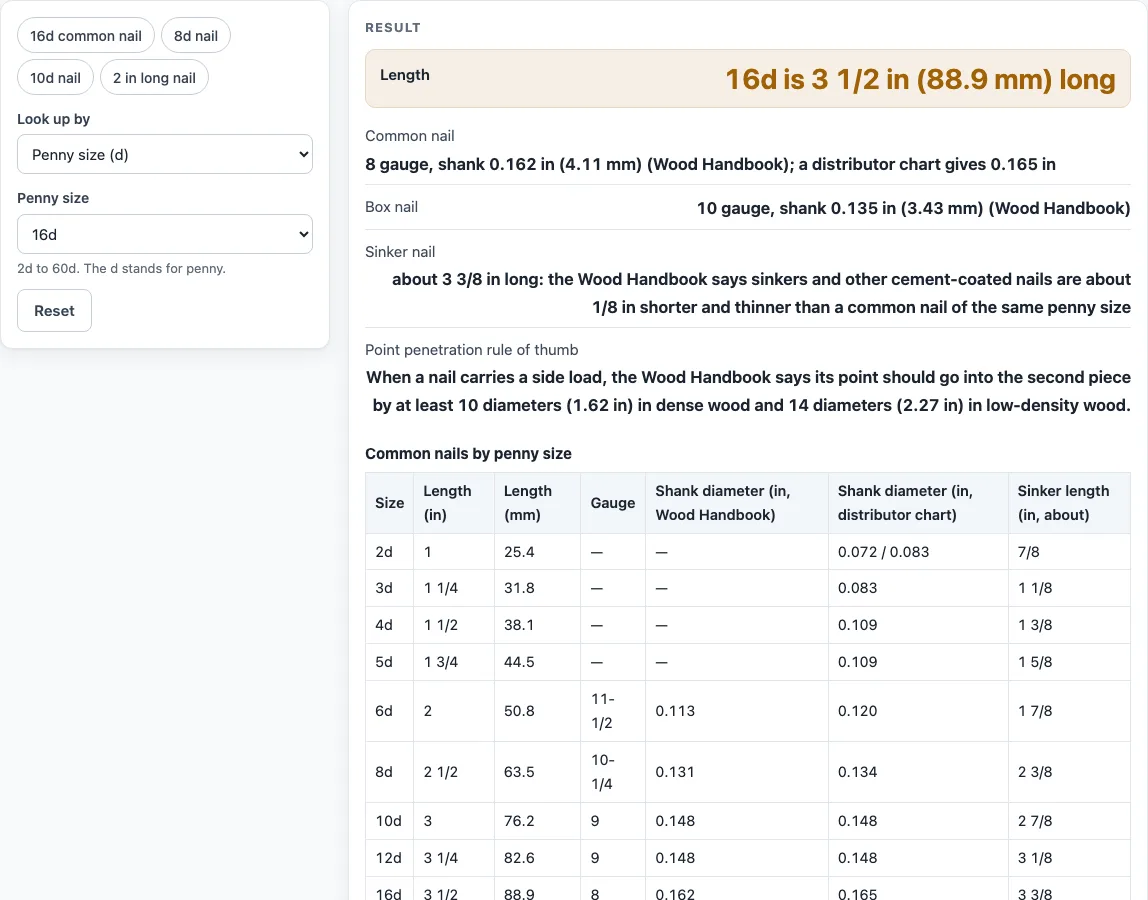
- If you do not choose anything, the page shows 16d: 3 1/2 in long (88.9 mm), common nail 8 gauge, with a shank of 0.162 in (4.11 mm) in the Wood Handbook and 0.165 in in a distributor chart.
How does a penny size relate to nail length?
A penny size is a label, not a measurement. Each penny size maps to a typical length, and the length grows as the penny number grows: 3 in is 10d, 2 in is 6d and 6 in is 60d. The Wood Handbook says penny sizes are obsolete and recommends specifying nails by length and diameter, which is why this tool shows length in both inches and millimetres. One inch equals 25.4 mm, so a 3 in nail is 76.2 mm long.
Use the length, not the penny size, when a project or a plan gives measurements. A penny size from one source may not match a nail from another maker, so the length and diameter are the more reliable pair to check.
Why do shank diameters differ between sources and nail types?
The shank is the body of the nail between the head and the point. Its diameter depends on the source and on the nail type. Common nails, box nails and sinkers of the same penny size do not have the same shank, and the tool does not mix them.
Box nails are thinner than common nails of the same penny size. For example, the Wood Handbook gives a 6d common nail a 0.113 in shank and a 6d box nail 0.099 in. Sinker nails and other cement-coated nails are about 1/8 in shorter and thinner than common nails of the same penny size. The page shows sinker length only, such as about 3 3/8 in for 16d, because no sinker diameter table was found.
Sources also disagree. The 60d shank is 0.262 in in the Wood Handbook and 0.238 in in the distributor chart. The 16d value is 0.162 in against 0.165 in, and 6d is 0.113 in against 0.120 in. Sizes 2d to 5d come only from the distributor chart. Finish nails are not covered by this tool.
Shank diameter matters because of penetration. The Wood Handbook gives a rule of thumb for side-loaded nails: at least 10 diameters of penetration in dense wood and 14 diameters in low-density wood. For a 16d nail of 0.162 in, that works out to 1.62 in to 2.27 in. This is a calculation from the rule, not a guarantee for your wood or your project.
Sources (checked 15 October 2026): research.fs.usda.gov · allpointsfasteners.com
Worked examples
| Input | Result |
|---|---|
| 16d nail | 3 1/2 in long (88.9 mm) |
| 8d nail | 2 1/2 in long (63.5 mm) |
| 2d nail | 1 in long (25.4 mm) |
| 10d nail | 3 in long (76.2 mm) |
| 60d nail | 6 in long (152.4 mm) |
Calculated by the tool above; open it with the same values to see each step.
Frequently asked questions
Is this nail size chart free to use?
Yes. The tool is free, and it does not require a sign-up. Everything is calculated in your browser.
Does the tool upload the sizes I enter?
No. Everything is calculated in your browser, and nothing is uploaded.
Why do some sizes show two shank diameters?
The Wood Handbook and the distributor chart do not always agree. The tool shows both values in separate columns so you can see the difference. Nothing is averaged.
Why does the chart show a warning for 60d and 2d?
The sources disagree on the 60d shank, and the distributor chart lists 2d in two gauges. Read the warning before you rely on those sizes.
Do these sizes replace the rules for my project?
No. The results are typical sizes from the named sources. They are not a code approval or a safety rating. Check the rules that apply to your project and the specification of your nails.
What does the d in 8d or 16d mean?
It stands for penny. The Wood Handbook says penny sizes are obsolete and recommends giving the length and diameter instead.
What is a sinker nail?
The Wood Handbook says sinkers and other cement-coated nails are about 1/8 in shorter and thinner than common nails of the same penny size. This page shows the sinker length only.
Does the chart cover finish nails?
No. No public table with individual finish nail values was read, so finish nails are not covered.
Related tools
- Lag Screw Pilot Hole Size Chart: Use it when you need the pilot hole size before driving a lag screw into wood.
- Metric Bolt Size Chart: Use it when you are working with metric bolt sizes instead of nails.
- How Many Screws per Sheet of Drywall: Use it when you are estimating how many screws a drywall job needs.
- Wood Screw Size Chart: Use it when you need sizes for wood screws rather than nails.
- Nails, Screws and Bolts: Use it to see every fastener tool on the site in one place.
- Lumber Dimensions: Use it to check the actual thickness of the lumber your nail goes into.