Metric Bolt Size Chart
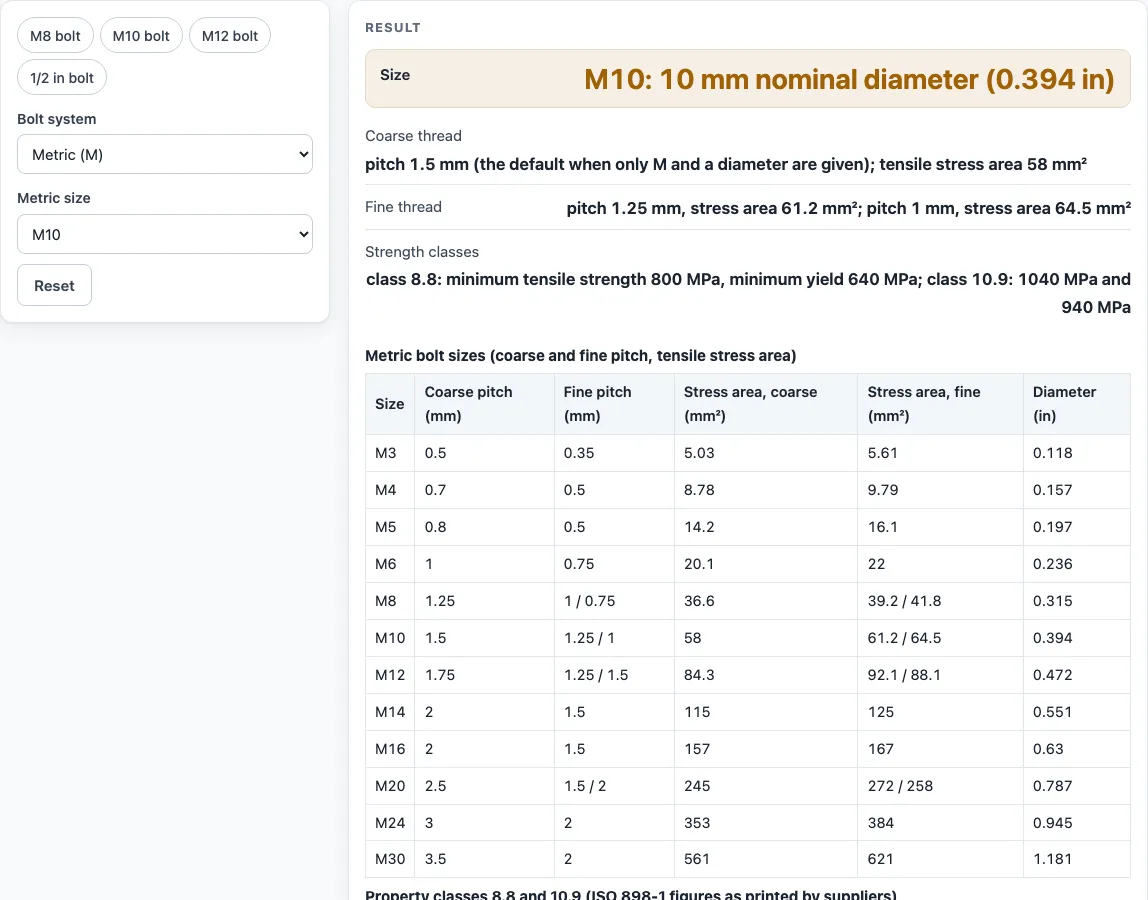
Pick a metric size (M3 to M30) or a US bolt size to see its thread pitch, tensile stress area and the strength of classes 8.8 and 10.9.
Recent
Your last 10 settings, saved only in this browser. Nothing is uploaded.
How to use the metric bolt size chart
- Open the chart at the top of this page.
- Leave “Bolt system” on Metric (M) and pick a “Metric size” from M3 to M30, such as M10. For a US bolt, set “Bolt system” to US inch (UNC / UNF) and pick a “US size (in)” from 1/4 to 1 in instead.
- Read the coarse pitch. When only the size is written, such as M10, the coarse pitch is meant. For M10 it is 1.5 mm.
- Check the fine pitch if your nut or hole uses a finer thread. For M10 the fine pitches are 1.25 mm and 1 mm.
- Read the tensile stress area in mm² next to each pitch in the “Coarse thread” and “Fine thread” results. For M10 at 1.5 mm it is 58.0 mm², at 1.25 mm it is 61.2 mm², and at 1 mm it is 64.5 mm².
- For US sizes, read the decimal and mm diameter and the threads per inch for UNC or UNF. For 1/2 in, that is 13 UNC or 20 UNF threads per inch.
- Read the strength class lines if you need them. Classes 8.8 and 10.9 are listed from M5 up. M3 and M4 show a note instead.
- Note the M12 fine pitch conflict. The ISO thread page lists 1.5 or 1.25 mm, and the supplier stress-area table lists 1.25 mm. Both are shown.
The M8, M10, M12 and 1/2 in presets jump straight to common sizes. This page has no load tables, torque values, or wrench sizes, so look those up from your maker’s data or the governing standard.
What does pitch mean on a metric bolt size chart?
Pitch is the distance between one thread and the next, measured along the bolt. On a metric bolt size chart, a size written alone, such as M10, refers to its coarse pitch, which is 1.5 mm. Coarse pitches listed from ISO 262 are 0.5 mm for M3, 0.7 mm for M4, 0.8 mm for M5, 1 mm for M6, 1.25 mm for M8, 1.5 mm for M10, 1.75 mm for M12, 2 mm for M14 and M16, 2.5 mm for M20, 3 mm for M24, and 3.5 mm for M30.
Some sizes also have fine pitches, which are smaller distances between threads. M8 x 1 is one example of a fine thread. A fine thread and a coarse thread of the same diameter are not interchangeable, so check the pitch before you choose a nut or tap a hole.
How is tensile stress area calculated for a bolt?
The tool calculates tensile stress area as pi/4 times (d minus 0.9382 times P) squared, where d is the nominal diameter and P is the pitch in mm. This is the same as pi/4 times ((d2 + d3)/2) squared, the definition used in ISO 898-1. Every coarse and fine value printed in the supplier table matches this result within 0.5 %.
Here is the M10 example at coarse pitch. The calculation is 10 minus 0.9382 times 1.5, which gives 8.593. Squaring that gives 73.84, and multiplying by pi/4 (0.7854) gives 58.0 mm². The same method gives 61.2 mm² at 1.25 mm pitch and 64.5 mm² at 1 mm pitch. A finer pitch leaves a larger stress area for the same diameter.
Stress area is one input to strength, and strength classes add more. Class 8.8 has a minimum tensile strength of 800 MPa for M5 to M16 and 830 MPa above M16, with a minimum yield of 640 or 660 MPa. Class 10.9 has a minimum tensile strength of 1040 MPa and a minimum yield of 940 MPa. The nominal tensile values are 800 MPa for class 8.8 and 1000 MPa for class 10.9. The minimum figures come from supplier tables of ISO 898-1, and the nominal values are shown separately in the class table. The page lists classes only for M5 and up, because the sources used do not cover M3 and M4.
Sources (checked 15 October 2026): en.wikipedia.org · crafter.fastenal.com · trfastenings.com · amesweb.info
Worked examples
| Input | Result |
|---|---|
| M10 bolt | coarse stress area 58 mm² |
| M8 bolt | coarse stress area 36.6 mm² |
| M20 bolt | coarse stress area 245 mm² |
| 3/8 in bolt | UNC 16, UNF 24 threads per inch |
| M3 bolt | coarse stress area 5.03 mm² |
Calculated by the tool above; open it with the same values to see each step.
Frequently asked questions
What does M10 mean on a bolt?
M10 means a metric thread with a nominal diameter of 10 mm. When no pitch is given, the coarse pitch is meant, which is 1.5 mm for M10. The chart also lists M10 fine pitches of 1.25 mm and 1 mm.
Why does M12 show two fine pitches?
The sources disagree on the M12 fine pitch. The ISO thread page lists 1.5 or 1.25 mm, while the supplier stress-area table lists 1.25 mm. Both values are shown so you can check the one that matches your part.
Does this chart cover US bolt sizes?
Yes. The chart covers US bolts from 1/4 to 1 in and shows the decimal and mm diameter and the threads per inch. The thread pitch in mm is 25.4 divided by the threads per inch, so 1/2 in UNC has a pitch of 1.954 mm.
Are strength classes listed for M3 and M4?
No. Strength classes are listed from M5 up in the sources used, and M3 and M4 show a note instead. Check your fastener data for those smaller sizes.
Does the page give torque values or load ratings?
No. The page has no load tables and no torque values, and it does not give wrench sizes or head widths. It shows sizes, pitches, stress areas, and strength class figures only.
Do bolt sizes stay the same across every maker?
No. Sizes vary by maker, so the values here are typical sizes from the named sources and calculated results from your inputs. The governing standard, ISO 262, ISO 898-1, or ASME B1.1, is the reference for your job.
Related tools
- Lag Screw Pilot Hole Size Chart: Use it when you need the pilot hole size for a lag screw before drilling.
- Nail Size Chart: Use it when you are comparing nail sizes for a fastening job.
- How Many Screws per Sheet of Drywall: Use it when you are planning how many screws a drywall sheet needs.
- Wood Screw Size Chart: Use it when you are choosing a wood screw by size.
- Nails, Screws and Bolts: The full set of fastener tools on this site.
- Lumber Dimensions: Use it when you need the actual size of a nominal board.
- Plywood Sizes: Use it when you need standard panel sizes.