Lumber Weight Calculator
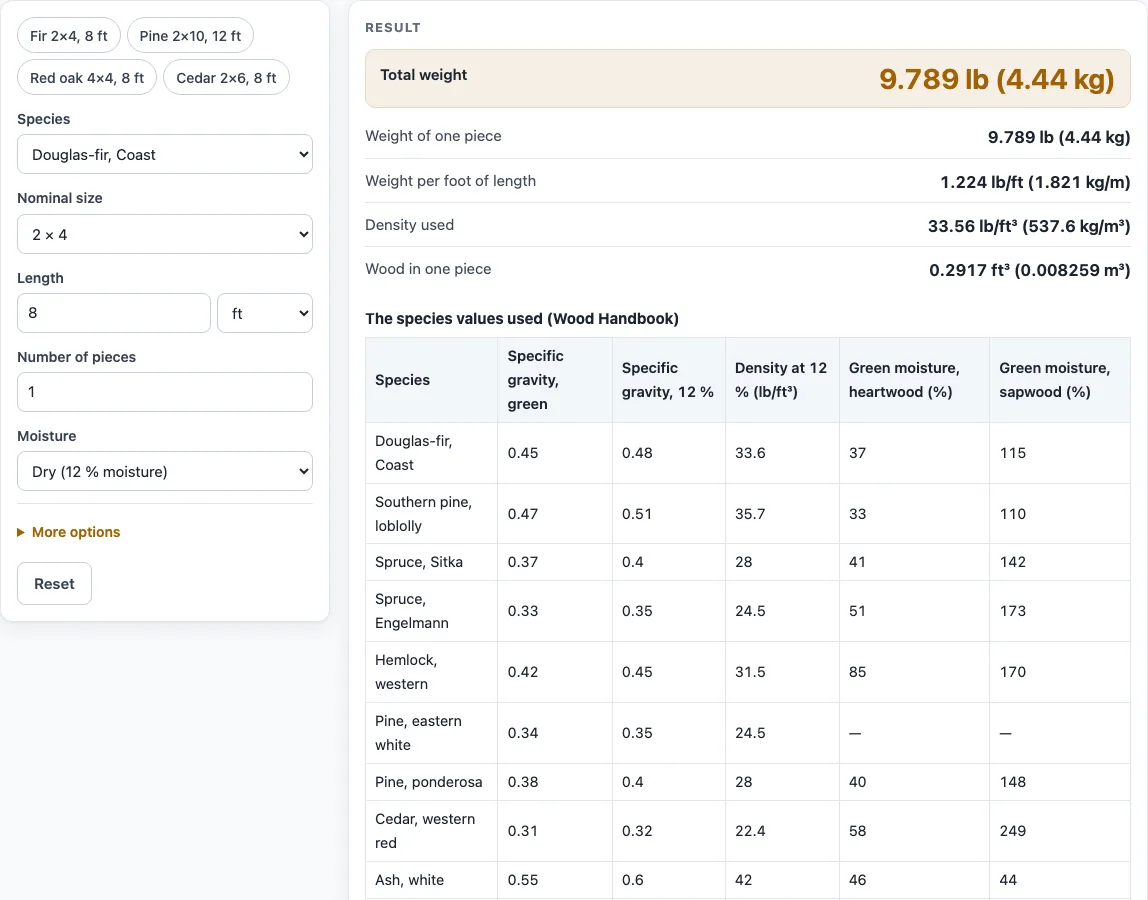
Choose a species, nominal size, length and number of pieces to get the weight in pounds and kilograms, dry or green, or type your own density.
Recent
Your last 10 settings, saved only in this browser. Nothing is uploaded.
How to use the Lumber Weight Calculator
- Choose a species from the list of 13. If you know the density of your wood, pick “My own density” instead.
- Select a nominal size. The list has 23 sizes, from 1x2 to 10x10. Nominal is the name the lumber is sold under. The tool uses the actual dressed size for volume.
- Enter the length and pick its unit: ft, in, or m.
- Enter the number of pieces as a whole number. Decimals and zero or negative lengths cause an error.
- Set moisture to “dry” (12 %) or “green”. For green wood, open “More options” and type a moisture content in percent. If you leave it blank, the heartwood average is used (37 % for Douglas-fir coast), and a warning shows that the sapwood average is higher (115 %).
- If you chose “My own density”, type a number in lb/ft3 or kg/m3. Values below 10 or above 75 lb/ft3 trigger a warning.
- Read the results: total weight (lb and kg), weight of one piece, weight per foot (lb/ft and kg/m), density used (lb/ft3 and kg/m3), and volume of wood in one piece (ft3 and m3).
To start quickly, use one of the presets: Fir 2x4 8 ft, Pine 2x10 12 ft, Red oak 4x4 8 ft, or Cedar 2x6 8 ft. These weights are for clear wood averages, so adjust the inputs to match the boards you are actually buying.
How is the weight of lumber calculated?
Lumber weight equals wood volume multiplied by density. The tool finds the volume of each piece from its dressed thickness, width, and length, multiplies by the number of pieces, and then applies a density for the species and moisture state.
Volume uses the actual size, not the nominal name. A dry 2x4 is 1-1/2 x 3-1/2 in, so an 8 ft piece holds 504 in3, or 0.2917 ft3, of wood. A green 2x4 is slightly larger at 1-9/16 x 3-9/16 in.
Why does moisture change the weight?
Water is heavy, so wet wood weighs more than dry wood of the same size. For dry wood (12 %), the density is 62.43 lb/ft3 x G12 x 1.12, where G12 is the specific gravity at 12 % moisture. For green wood, the density is 62.43 lb/ft3 x Gb x (1 + MC/100), where Gb is the green specific gravity and MC is the moisture content in percent.
For example, a green Douglas-fir coast 2x4 at the 37 % heartwood average has a density of 38.49 lb/ft3 and weighs 11.9 lb (5.40 kg). A dry piece of the same length weighs 9.789 lb (4.44 kg). The difference comes from the water and the larger green size.
Where do the specific gravity values come from?
Specific gravity values come from Table 5-3b of the USDA Forest Products Laboratory Wood Handbook. The tool uses only these values, so its results may differ from figures you find elsewhere. For example, loblolly pine is 0.51 and white oak is 0.68 at 12 % moisture. The page includes a table of green and 12 % values for every listed species.
Why might a real board weigh more or less than the result?
The result assumes clear wood with typical values. Knots, grain, drying, grade, and treatment chemicals all change the real weight. The Wood Handbook calls its moisture averages typical and notes that variation within and between trees is considerable. Timbers, which are 5 in and thicker, are often sold undried, so a dry weight may be too low for them.
How do I calculate the weight of wood that is not on the list?
Choose “My own density” and type a density in lb/ft3 or kg/m3. The volume still uses the dry dressed size. For example, a density of 40 lb/ft3 gives 11.67 lb for a 2x4 that is 8 ft long. Check your figure against a reliable reference for your species before relying on it.
Sources (checked 15 October 2026): research.fs.usda.gov · nist.gov · research.fs.usda.gov
Worked examples
| Input | Result |
|---|---|
| 2 × 4, 8 ft, 1 piece(s), Douglas-fir, Coast | 9.789 lb (4.44 kg) |
| 2 × 10, 12 ft, 10 piece(s), Southern pine, loblolly | 412.3 lb (187 kg) |
| 4 × 4, 8 ft, 1 piece(s), Oak, northern red | 29.98 lb (13.6 kg) |
| 2 × 4, 8 ft, 1 piece(s), Douglas-fir, Coast | 11.9 lb (5.399 kg) |
| 2 × 4, 8 ft, 1 piece(s), My own density | 11.67 lb (5.292 kg) |
Calculated by the tool above; open it with the same values to see each step.
Frequently asked questions
Frequently asked questions
Is the Lumber Weight Calculator free?
Yes. It is free, it runs in your browser, nothing is uploaded, and you do not need to sign up.
How much does an 8 ft 2x4 weigh?
For Douglas-fir coast dried to 12 %, one piece weighs 9.789 lb (4.44 kg), or 1.224 lb per foot. This is calculated from the inputs, and real boards vary.
Why is green lumber heavier than dry lumber?
Green lumber contains water and has a larger dressed size than dry lumber. Both factors increase the weight, so a green piece is heavier than a dry piece of the same nominal size.
What happens if I leave the moisture content blank for green wood?
The tool uses the heartwood average of 37 % for Douglas-fir coast and shows a warning. Sapwood averages are higher, at 115 %, so a sapwood board would weigh more than the result.
Can I use this calculator for timbers?
You can, but timbers 5 in and thicker are often sold undried. A dry-weight result may be too low for them, so set the moisture to green if you know the wood is undried.
Why do other sites show different weights for the same species?
Some sites list different specific gravity values. This tool uses only Table 5-3b of the Wood Handbook, and it names that basis on the page.
Related tools
- 2x4 Dimensions: Check the actual dressed size of a 2x4 before you enter it.
- Board Foot Calculator: Estimate board feet when you are buying lumber by volume.
- Lumber Dimensions: Compare nominal and actual sizes across common lumber sizes.
- Stud Spacing Calculator: Work out stud spacing when you plan a wall frame.
- Floor Joist Spacing: Plan joist spacing when you are estimating a floor frame.
- Plywood Sizes: Look up sheet sizes if your project includes plywood as well as lumber.