Lag Screw Pilot Hole Size Chart
Pick the lag screw diameter and the kind of wood to see the shank hole and the lead hole range for the threads, in fractions, inches and mm.
Recent
Your last 10 settings, saved only in this browser. Nothing is uploaded.
How to use the Lag Screw Pilot Hole Size Chart
- Choose the “Lag screw diameter” from 1/4 to 1 in. The 3/8 and 1/2 in Douglas-fir presets, the 1/2 in oak preset and the 1/4 in cedar preset fill both fields at once.
- Choose the “Wood density group” your piece belongs to: low-density softwoods such as cedars and white pines, Douglas-fir and Southern Pine, or dense hardwoods such as oaks.
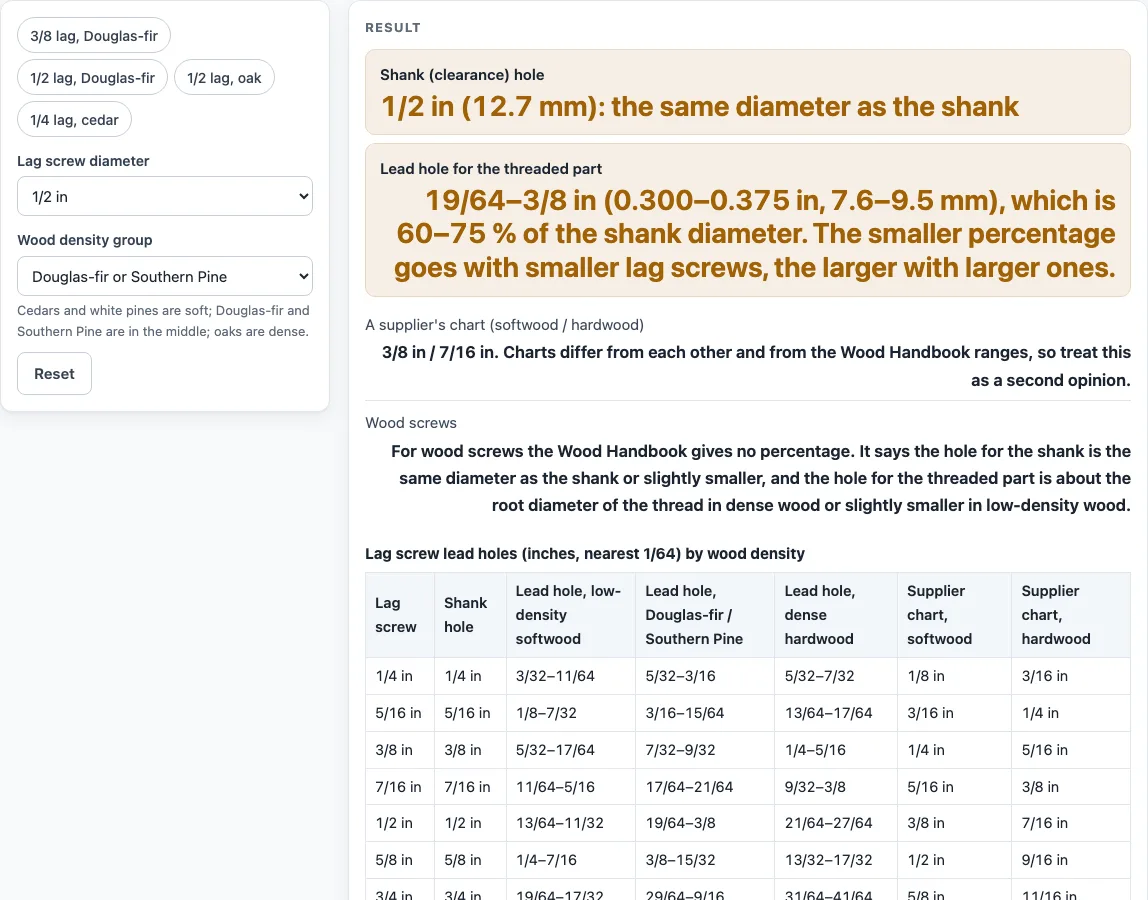
- Read the “Shank (clearance) hole” result. It matches the diameter of the lag screw shank. For a 1/2 in lag, this is a 1/2 in (12.7 mm) hole.
- Read the “Lead hole for the threaded part” result. This is the hole for the threaded part of the screw. The range is based on the share of shank diameter for your wood group.
- Find the nearest 1/64 in size on your drill bit set. Lead hole sizes are rounded to the nearest 1/64 in.
- Compare the supplier chart beside the results. If the page shows a warning, the supplier value sits outside the handbook range for that wood group, so check the handbook figure first.
- Drill a test hole in a scrap piece of the same wood. Drive the screw with a wrench and soap or a similar lubricant. Never hammer a lag screw.
The page shows the whole handbook range for each input and does not pick a point inside it for you. Choose the size within the range that suits your screw and wood, then test before you drill the real piece.
What is a lag screw pilot hole?
A lag screw is a heavy wood screw with a square or hex head, driven with a wrench. A pilot hole is a hole drilled before the screw goes in. For a lag screw, two holes matter: a shank hole that lets the unthreaded part pass through the top piece, and a lead hole that the threaded part screws into. The Wood Handbook gives sizing guidance for both holes.
How is the lead hole size calculated from the shank diameter?
The lead hole is set as a percentage of the lag screw’s shank diameter. The Wood Handbook gives 40 to 70 percent for low-density softwoods such as cedars and white pines, 60 to 75 percent for Douglas-fir and Southern Pine, and 65 to 85 percent for dense hardwoods such as oaks. Multiply the shank diameter by the low and high percentages to get the range.
For example, a 1/2 in lag screw in Douglas-fir or Southern Pine gives 0.5 × 0.60 = 0.300 in and 0.5 × 0.75 = 0.375 in. Rounded to the nearest 1/64 in, that is 19/64 to 3/8 in, or 7.6 to 9.5 mm.
Why does the lead hole range depend on wood density?
Denser wood resists the threads more, so it needs a lead hole that takes up more of the shank diameter. Low-density softwoods need a smaller percentage. The handbook also says the smaller percentage in each range goes with smaller lag screws and the larger percentage with larger ones. The page shows the full range and does not interpolate between the ends.
Why do the supplier chart and the handbook sometimes disagree?
A supplier’s chart lists one softwood value and one hardwood value for each diameter. Those values do not always fall inside the handbook range. For a 1/2 in lag screw in softwood, the supplier value of 3/8 in is 75 percent of the shank diameter, which is above the 70 percent top of the handbook range for soft woods. Other diameters from 7/16 in up also list softwood values above 70 percent. Both figures are shown, and the page warning names the mismatch. Charts vary by maker, so compare both and test in a scrap piece.
Why is there a separate shank hole?
The shank (clearance) hole is for the unthreaded shank of the screw. The handbook sets the shank hole equal to the shank diameter for lag screws, so a 1/2 in lag screw has a 1/2 in (12.7 mm) shank hole.
How do wood screws differ from lag screws?
For wood screws, the handbook says the shank hole is the same size as the shank or slightly smaller. The hole for the threads is the root diameter in dense wood, or slightly smaller in low-density wood. No fraction chart is given for wood screws, so this page does not produce wood screw sizes.
Sources (checked 15 October 2026): research.fs.usda.gov · us.misumi-ec.com
Worked examples
| Input | Result |
|---|---|
| 1/2 in lag screw, Douglas-fir or Southern Pine | lead hole 0.300–0.375 in |
| 3/8 in lag screw, Low-density softwood | lead hole 0.150–0.263 in |
| 3/8 in lag screw, Dense hardwood | lead hole 0.244–0.319 in |
| 1/4 in lag screw, Douglas-fir or Southern Pine | lead hole 0.150–0.188 in |
| 1 in lag screw, Dense hardwood | lead hole 0.650–0.850 in |
Calculated by the tool above; open it with the same values to see each step.
Frequently asked questions
What lead hole size do I need for a 1/2 in lag screw in Douglas-fir or Southern Pine?
The range is 0.300 to 0.375 in, which rounds to 19/64 to 3/8 in (7.6 to 9.5 mm). Test in a scrap piece first.
Why does the page show a range instead of one size?
The Wood Handbook gives a percentage range for each wood group, and the page does not pick a point inside it. Choose a size within the range that suits your screw and wood.
Should the shank hole be the same size as the lag screw?
Yes, for lag screws the handbook sets the shank hole equal to the shank diameter. A 1/2 in lag screw uses a 1/2 in (12.7 mm) shank hole.
What does the warning on the supplier chart mean?
It means a supplier value sits above the top of the handbook range for that wood group. The handbook figure is the value to check first.
Does this page cover wood screws?
No. The handbook gives no fraction chart for wood screws, so this page covers lag screws only. The wood screw size chart page covers wood screws.
Are the results a code requirement?
No. The results are calculated from your inputs and the Wood Handbook percentages, with a supplier chart shown beside them. They are a reference only, and any local building requirements are separate.
Related tools
- Metric Bolt Size Chart: Use it when your fasteners are listed in metric sizes instead of inches.
- Nail Size Chart: Use it when you are choosing nails instead of screws.
- How Many Screws per Sheet of Drywall: Use it when you are planning drywall screw counts for a wall or ceiling.
- Wood Screw Size Chart: Use it when you need sizes for wood screws, which this page does not cover.
- Nails, Screws and Bolts: The full set of fastener tools on this site.
- 2x4 Dimensions: Use it when you need the actual size of a 2x4.
- Lumber Dimensions: Use it when you need the actual size of a nominal board.