Janka Hardness Scale
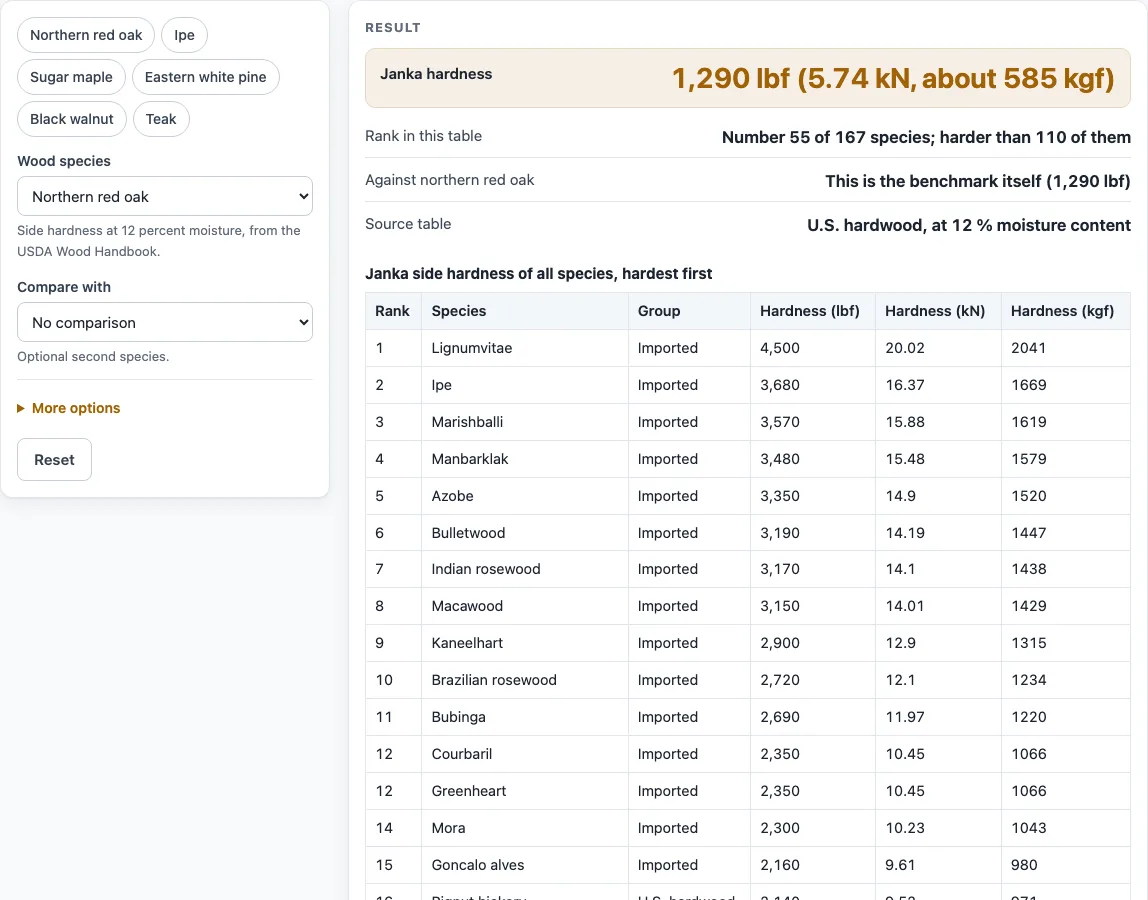
Pick a wood to see its Janka hardness in lbf, kN and kgf, its rank among 167 species and how it compares with northern red oak or a second wood.
Recent
Your last 10 settings, saved only in this browser. Nothing is uploaded.
The Janka hardness scale measures how well a wood resists denting, as the force needed to push a steel ball into the surface. This free tool works as a Janka hardness chart: pick a wood and it shows the hardness in pounds-force (lbf), kilonewtons and kilograms-force, where the wood ranks among 167 species, and how it compares with northern red oak. You can also pick a second wood to compare, and the table below the result lists every species from the hardest down. It runs in your browser, nothing is uploaded, and no sign-up is needed.
All the numbers come from one source, the USDA Forest Products Laboratory’s Wood Handbook (2010 edition). Flooring makers and wood databases quote their own Janka numbers, and those can differ from the Handbook for the same species, so compare numbers only within one source.
How to use the Janka Hardness Scale tool
- Choose the “Wood species”. The list has 167 woods: U.S. hardwoods such as oak, maple and walnut, U.S. softwoods such as pine, fir and cedar, and imported woods such as ipe, teak and sapele.
- Read “Janka hardness”. It gives the side hardness in lbf, plus the same value in kN and kgf.
- Read “Rank in this table”. It shows the species’ number from the hardest, and how many species in the table are softer.
- Read “Against northern red oak”. Northern red oak (1,290 lbf) is the benchmark here because it is the common reference for flooring and furniture.
- To compare two woods, pick a second species under “Compare with”. The “Comparison” output shows how many times as hard one is and the difference in lbf.
- Open “More options” to change “Table shows” and list all species, only U.S. hardwoods, only U.S. softwoods or only imported woods in the table below the result.
- Read any warning. One appears for imported woods, and one for woods the Handbook gives at 15 % moisture instead of 12 %.
- The six preset buttons jump to northern red oak, ipe, sugar maple, eastern white pine, black walnut and teak.
With no changes the page shows northern red oak: 1,290 lbf.
What does the Janka hardness number mean?
The Wood Handbook defines hardness as resistance to indentation, measured by the load needed to embed an 11.28 mm (0.444 in) ball to half its diameter. The values are side hardness, the average of the radial and tangential faces, tested on clear specimens at 12 percent moisture. A higher number means a wood dents less. Northern red oak is 1,290 lbf, sugar maple 1,450 lbf and black walnut 1,010 lbf. Eastern white pine is 380 lbf, so oak is about 3.4 times as hard. Ipe is 3,680 lbf, about 2.9 times as hard as oak, and lignumvitae at 4,500 lbf is the hardest wood in the table.
Conversion is plain arithmetic: 1 lbf is 4.4482 N, so 1,290 lbf is 5.74 kN, and 1 lbf is 0.4536 kgf, so it is about 585 kgf. The tool does the conversion for you.
How hard is hardwood compared with softwood?
The names describe the tree, not the hardness, and the table shows it. The hardest U.S. softwood in the table is longleaf pine at 870 lbf, which is softer than many U.S. hardwoods but harder than aspen (350 lbf), basswood (410 lbf) and black cottonwood (350 lbf). Among hardwoods, the hickories reach about 1,800 to 2,150 lbf, and the imported woods in the table run from ceiba at 240 lbf to ipe, bulletwood, marishballi and lignumvitae above 3,000 lbf.
Use the number as a guide to dent resistance, not a full rating of a floor or a worktop. Finish, plank construction and wear layer matter too, and the Handbook’s imported-species table is taken from the world literature, so its sample may not represent every lot sold under that name.
Sources (checked 17 October 2026): USDA Forest Products Laboratory, Wood Handbook FPL-GTR-190 (2010), chapter 5
Worked examples
| Input | Result |
|---|---|
| Northern red oak | 1,290 lbf, number 55 of 167 |
| Ipe | 3,680 lbf, number 2 of 167 |
| Eastern white pine | 380 lbf, number 156 of 167 |
| Sugar maple | 1,450 lbf, number 45 of 167 |
| Lignumvitae | 4,500 lbf, number 1 of 167 |
Calculated by the tool above; open it with the same values to see each step.
Frequently asked questions
What is the Janka hardness of oak?
In the Wood Handbook, northern red oak is 1,290 lbf and white oak is 1,360 lbf at 12 percent moisture. Other oaks in the table range from 1,060 lbf (southern red oak) to 1,620 lbf (swamp white oak).
Which wood is hardest on the Janka scale?
In this table, lignumvitae is the hardest at 4,500 lbf, followed by ipe (3,680 lbf), marishballi (3,570 lbf), manbarklak (3,480 lbf) and azobe (3,350 lbf). Other lists that include more species may rank differently.
Why do other Janka lists show different numbers?
Each list is built from its own tests and samples, and wood varies from tree to tree. This tool uses a single source, the Wood Handbook, so the numbers are consistent with each other.
Is a higher Janka number always better?
No. A higher number means more resistance to denting, but hard woods are also harder to cut, nail and sand, and the number says nothing about stability, rot resistance or looks.
Does the Janka number change with moisture?
Yes. The Handbook values are at 12 percent moisture, and most woods are harder when drier. Jelutong, merbau and white meranti are given at 15 percent, and the tool says so.
Does the tool upload what I enter?
No. It runs in your browser and nothing is uploaded.
Related tools
- Lumber Weight Calculator: Use it to estimate the weight of the lumber you pick.
- Board Foot Calculator: Use it to measure and price hardwood by the board foot.
- Lumber Dimensions: Use it to check nominal and actual lumber sizes.
- Plywood Thickness: Use it to check plywood thicknesses.
- Lumber, Plywood and Framing: Use it to see all the lumber and framing tools in one place.