Board Foot Calculator
Enter the thickness, width, length and number of pieces to get board feet, plus cubic feet, cubic meters and cost if you type a price per board foot.
Recent
Your last 10 settings, saved only in this browser. Nothing is uploaded.
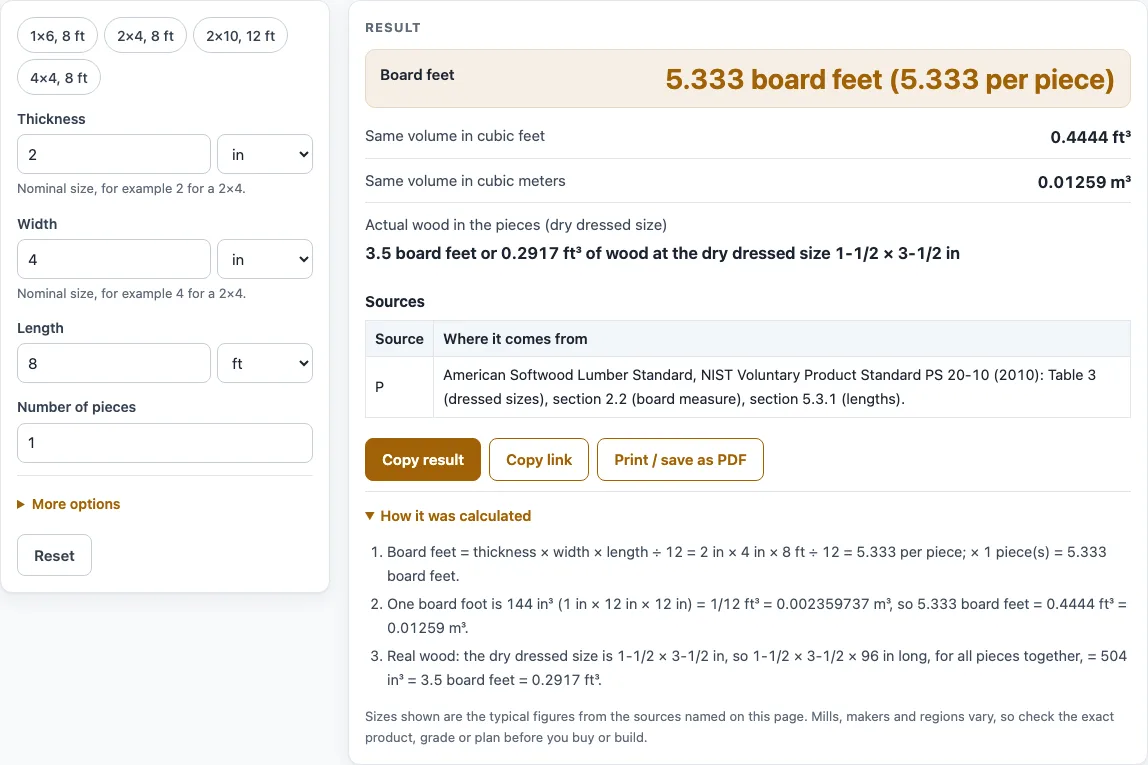
How to use the Board Foot Calculator
- Enter the thickness and width in the size fields. Choose in, mm or cm for each. For a 2 x 4, type 2 and 4 in.
- Enter the length and choose its unit: ft, in, m or cm. For an 8 ft board, type 8 and choose ft.
- Type the number of pieces as a whole number, such as 5.
- Or start from a preset: 1x6 8 ft, 2x4 8 ft, 2x10 12 ft or 4x4 8 ft.
- Open “More options” and check the basis. “Nominal size (trade practice)” is the default. Choose “Actual size as typed” for rough hardwood or when you have measured the real size.
- If you want waste counted, type a waste allowance from 0 to 100 percent. The board feet with waste appear only when the allowance is above 0.
- If you want a cost, type a price per board foot. The cost appears only when a price is typed.
- Read the board feet and the figure per piece. Then check the steps list, which shows the formula with your numbers.
- Read any warning before you use the result. Warnings appear for a waste allowance above 30 %, a length above 40 ft, or the actual basis with nominal-looking numbers. Errors appear for a missing or non-positive size, a number of pieces that is not whole, a waste allowance above 100 %, or a negative price. Correct these before reading the result.
Use the steps list to check the arithmetic by hand, especially when you change the basis.
What is a board foot?
A board foot is a unit of volume for sawn wood. It equals 1 inch thick, 12 inches wide and 12 inches long, which is 144 cubic inches. It lets you compare pieces of different sizes on one scale.
How is the number of board feet calculated?
Multiply the thickness in inches by the width in inches and by the length in feet, divide by 12, then multiply by the number of pieces. A 1 x 6 x 8 ft board is 1 x 6 x 8 / 12 = 4 board feet exactly. The same board in metric units, 25.4 mm x 152.4 mm x 2.4384 m, is also 4 board feet, because the tool converts each unit before it applies the formula.
Why does nominal size give a different answer?
Two sources say surfaced softwood is sold on nominal size: PS 20-10 section 2.2 and a general board-foot reference. Under the nominal basis, a 2 x 4 x 8 ft board counts as 2 x 4 x 8 / 12 = 5.333 board feet. The real wood is about 1-1/2 x 3-1/2 in, so it holds 504 cubic inches, which is 3.5 board feet or 0.2917 ft3.
When the thickness and width are standard sizes, the page also shows the real wood. For a 2 x 10, PS 20-10 Table 3 gives a dry dressed size of 1-1/2 x 9-1/4 in. Table 3 lists minimum dressed sizes, so measure the piece you are buying. In the five-board example, five 2 x 10 x 12 ft boards count as 100 board feet on the nominal basis, but the real wood in them is 69.38 board feet.
When should I use the actual size basis?
Hardwoods are normally measured on actual size, so use “Actual size as typed” for rough hardwood. Use it also when you have measured the real piece and want the figure from those numbers. For example, 1.5 x 3.5 x 96 in gives 3.5 board feet on this basis.
The tool warns when you choose the actual basis and the numbers look like nominal sizes. That warning applies when the thickness is 1, 2, 3 or 4 in and the width is 2, 3, 4, 6, 8, 10 or 12 in.
How do waste and price change the total?
The waste allowance is a percentage you type. The tool does not assume any waste. Board feet with waste equal the board feet multiplied by 1 plus the allowance. In the five-board example, 100 board feet with 10 % waste gives 110 board feet.
Cost equals the board feet with waste multiplied by the price per board foot. At $3.50 per board foot, 110 board feet costs $385.00. The tool does not know the species, grade or region, so the price is whatever you enter.
How do the cubic measures relate to board feet?
One board foot is 144 cubic inches, and one cubic foot is 1,728 cubic inches. The cubic foot figure equals board feet x 144 / 1728, which is board feet divided by 12. The cubic meter figure equals board feet x 0.002359737216.
For the starting values, 2 x 4 x 8 ft on the nominal basis gives 5.333 board feet, 0.4444 ft3 and 0.01259 m3.
Sources (checked 15 October 2026): nist.gov · en.wikipedia.org
Worked examples
| Input | Result |
|---|---|
| 2 × 4 in × 8 ft, 1 piece(s), Nominal size (trade practice) | 5.333 board feet |
| 1 × 6 in × 8 ft, 1 piece(s), Nominal size (trade practice) | 4 board feet |
| 2 × 10 in × 12 ft, 5 piece(s), Nominal size (trade practice) | 100 board feet |
| 1.5 × 3.5 in × 8 ft, 1 piece(s), Actual size as typed | 3.5 board feet |
| 1 × 6 in × 8 ft, 1 piece(s), Nominal size (trade practice) | 4 board feet |
Calculated by the tool above; open it with the same values to see each step.
Frequently asked questions
Is one board foot the same as one cubic foot?
No. One board foot is 144 cubic inches, which is one twelfth of a cubic foot. The tool shows the cubic foot figure by dividing the board feet by 12.
Why does my 2 x 4 show 5.333 board feet?
The default basis is “Nominal size (trade practice)”, so a 2 x 4 x 8 ft board is calculated as 2 x 4 x 8 / 12. Choose “Actual size as typed” under “More options” and type 1.5 x 3.5 x 96 in, which gives 3.5 board feet.
Can I enter measurements in millimeters?
Yes. Thickness and width accept in, mm or cm, and length accepts ft, in, m or cm. The same 1 x 6 x 8 ft board gives 4 board feet whether you type it in inches or as 25.4 mm x 152.4 mm x 2.4384 m.
Why does the tool show a warning about nominal-looking numbers?
On the actual basis, the tool warns when the thickness is 1, 2, 3 or 4 in and the width is 2, 3, 4, 6, 8, 10 or 12 in. Those are common nominal sizes, so check whether you meant the real measured size.
Why is there no cost in my result?
The cost appears only when you type a price per board foot. The tool does not supply a price of its own.
Does the tool account for species or grade?
No. The tool does not know the species, grade or region, so it cannot adjust for them. Results are calculated from the inputs you type.
Do I need an account to use it?
No. The tool is free, needs no sign-up, and runs in your browser. Nothing is uploaded.
Related tools
- 2x4 Dimensions: Use it to check the real dressed size of a 2x4 before you measure or buy.
- Floor Joist Spacing: Use it when you are planning joist layout for a floor.
- Lumber Dimensions: Use it to compare nominal and actual sizes for different lumber pieces.
- Lumber Weight Calculator: Use it when you need to estimate how heavy a piece of lumber is.
- Plywood Sizes: Use it to look up common sheet sizes for plywood.
- Plywood Thickness Chart: Use it to compare plywood thicknesses when you are choosing a panel.
- Stud Spacing Calculator: Use it when you are working out how far apart studs should be placed.