2x4 Dimensions
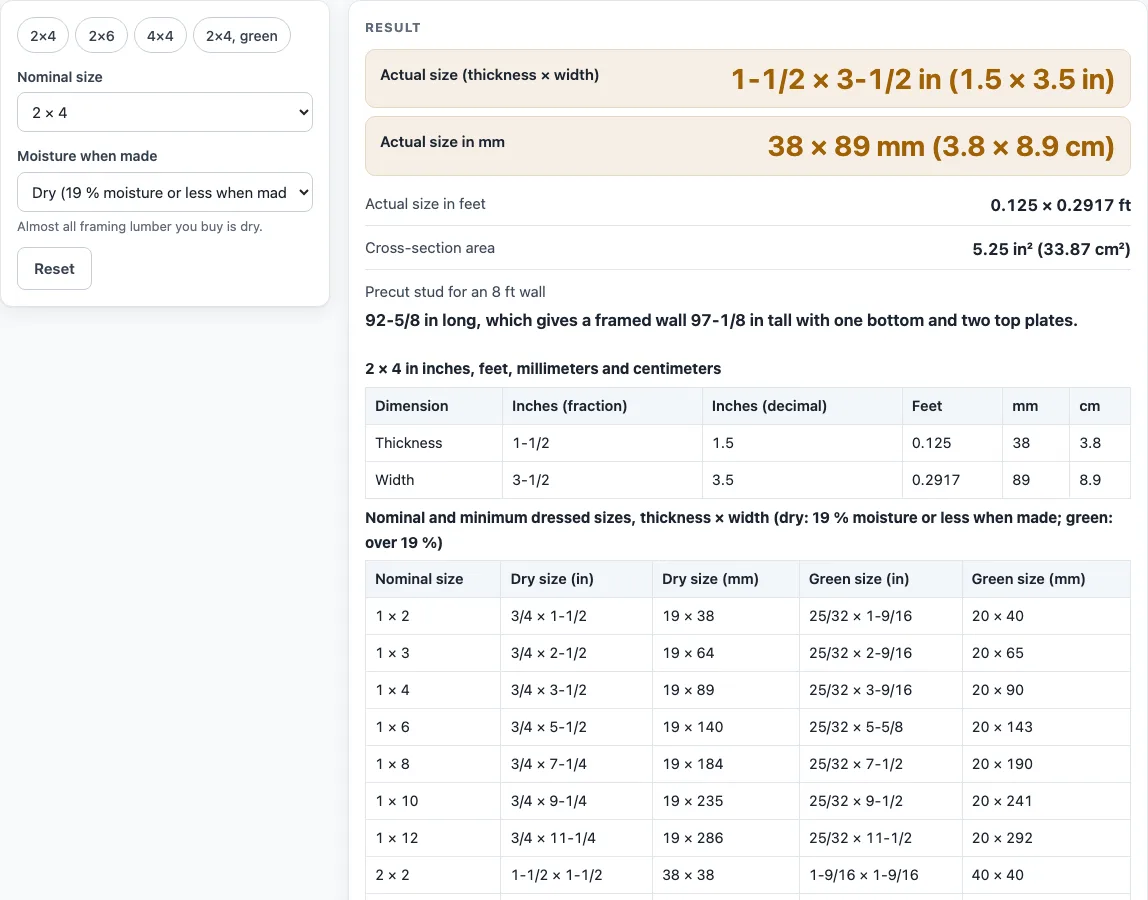
A 2x4 is really 1-1/2 x 3-1/2 in (38 x 89 mm); choose another nominal size or dry/green to see its actual dimensions in inches, feet, mm and cm.
Recent
Your last 10 settings, saved only in this browser. Nothing is uploaded.
How to use the 2x4 Dimensions Selector
- Open the selector at the top of this page. It loads in your browser, so there is nothing to install and no account to create.
- Choose the nominal size from the size list. For a standard wall stud, pick 2x4. The list holds 23 sizes: 1x2 to 1x12, 2x2 to 2x12, 4x4 to 4x12, 6x6, 6x8, 8x8 and 10x10.
- Choose dry or green. Pick dry if the lumber was 19 % moisture or less when it was made. Pick green if it was over 19 %.
- Read the actual size in inches as fractions. For a dry 2x4, the result is 1-1/2 x 3-1/2 in.
- Read the same size as decimals, in feet, in millimeters and in centimeters. For a dry 2x4, that is 0.125 x 0.2917 ft, 38 x 89 mm and 3.8 x 8.9 cm.
- Read the section area. For a dry 2x4, the cross-section is 5.25 in² (33.87 cm²).
- Compare the result with the board in front of you. Measure it, because the figures are minimums and mills vary slightly.
- Look at the tables below the selector. They list all nominal sizes with dry and green dressed sizes, the precut stud and framed wall height, and lumber lengths.
All outputs appear together, so you can check the inch, metric and area values in one view. Results are calculated from your inputs and the sizes in PS 20-10.
What are the actual dimensions of a 2x4?
A dry 2x4 is dressed to 1-1/2 x 3-1/2 in (38 x 89 mm). The name “2x4” is a nominal size, a trade label, and the dressed size is the figure that matches the board you hold. Those dry sizes come from Table 3 of PS 20-10, and a southern pine grading agency gives the same figures.
The dry figure applies when the lumber was 19 % moisture or less when it was made. Green 2x4s, over 19 % when made, are dressed to 1-9/16 x 3-9/16 in (40 x 90 mm). The standard’s sizes are minimums measured when the piece was made. Lumber shrinks or swells as its moisture changes, so a board can measure differently after it has dried or been stored.
Millimeters follow a simple rule. Multiply the dressed inch size by 25.4 and round to the nearest millimeter. So 1.5 in becomes 38 mm and 3.5 in becomes 89 mm.
The section area is the width times the thickness. For a dry 2x4, that is 1.5 × 3.5 = 5.25 in², or 33.87 cm² in metric.
Why is a 2x4 not 2 by 4 inches?
A 2x4 is smaller than 2 by 4 inches because “2x4” is a nominal name, a trade label, and PS 20-10 Table 3 lists a smaller dressed size for each nominal size. The southern pine grading agency puts it this way: a 2x4 and a 2x6 are 1/2 in narrower than nominal, while a 2x8 to a 2x12 are 3/4 in narrower.
Trade pages often quote the dressed size as the “actual” size. The standard gives those figures as minimums. Both agree for a dry 2x4 at 1-1/2 x 3-1/2 in.
Other dry sizes follow the same pattern. A 2x6 is 1-1/2 x 5-1/2 in (38 x 140 mm), a 4x4 is 3-1/2 x 3-1/2 in (89 x 89 mm), a 1x6 is 3/4 x 5-1/2 in (19 x 140 mm), and a 2x10 is 1-1/2 x 9-1/4 in (38 x 235 mm). A table on this page lists 18 nominal sizes with dry and green dressed sizes in inches and millimeters.
Which dimensions does this page show besides the size?
For every size you pick, the page shows the actual size as fractions and decimals of an inch, in feet, in millimeters and in centimeters, plus the cross-section area. Sizes with a 2 in nominal thickness also get a precut stud line. The tables below the selector show the full dry and green chart, the stud and wall height figures, and the lengths dimension lumber is made in.
Sources (checked 15 October 2026): nist.gov · blog.spib.org · hansenpolebuildings.com · capitolcitylumber.com · blog.spib.org
Worked examples
| Input | Result |
|---|---|
| Nominal 2 × 4, Dry (19 % moisture or less when made) | 1-1/2 × 3-1/2 in (38 × 89 mm) |
| Nominal 2 × 4, Green (over 19 % moisture when made) | 1-9/16 × 3-9/16 in (40 × 90 mm) |
| Nominal 2 × 6, Dry (19 % moisture or less when made) | 1-1/2 × 5-1/2 in (38 × 140 mm) |
| Nominal 4 × 4, Dry (19 % moisture or less when made) | 3-1/2 × 3-1/2 in (89 × 89 mm) |
| Nominal 6 × 6, Dry (19 % moisture or less when made) | 5-1/2 × 5-1/2 in (140 × 140 mm) |
Calculated by the tool above; open it with the same values to see each step.
Frequently asked questions
How long are 2x4 boards sold?
Lengths are multiples of 1 ft or 2 ft, as set by the grading rules. Dimension lumber is made from 6 to 24 ft. One lumber yard lists 2x4s in 8, 10, 12 and 16 ft, but what a store stocks varies, so check with your supplier.
What is the length of a precut 2x4 stud for an 8 ft wall?
A precut stud for an 8 ft wall is 92-5/8 in (2353 mm). With one 1-1/2 in bottom plate and a double top plate (3 in), the framed wall is 97-1/8 in (2467 mm) tall. That leaves room for 5/8 in ceiling drywall and keeps wall drywall about 1/2 in above the floor. Some framing articles mention 92-1/4 in precuts in some regions. This page does not list that size because it could not be tied to a public standard.
What is the actual size of a 2x6?
A dry 2x6 is 1-1/2 x 5-1/2 in (38 x 140 mm). Green 2x6s use the green dressed sizes, which the table on this page lists.
What sizes do 6x6 and 8x8 timbers measure?
A 6x6 is 5-1/2 x 5-1/2 in dry or green (140 mm). An 8x8 is 7-1/4 in dry and 7-1/2 in green. Timbers are often sold without drying, so measure the piece you buy.
Which sizes does the selector cover?
The selector covers 23 nominal sizes: 1x2 to 1x12, 2x2 to 2x12, 4x4 to 4x12, 6x6, 6x8, 8x8 and 10x10. You can choose dry or green for each one.
Does this page show the weight of a 2x4?
No. Weight and board feet are not on this page. Use the lumber weight calculator or the board foot calculator for those figures.
Related tools
- Lumber Dimensions: Use it to compare sizes across more lumber types.
- Board Foot Calculator: Use it when you need board feet for an order or a cut list.
- Lumber Weight Calculator: Use it when you need to estimate how heavy a piece of lumber is.
- Stud Spacing: Use it when you are laying out studs for a wall.
- Floor Joist Spacing: Use it when you are planning joists for a floor.
- Plywood Sizes: Use it when your project also uses sheet goods.